


Hair Loss Treatment: PRP, Mesotherapy, Hair Laser and Regenerative Treatments
Hair loss is one of the dermatological concerns that is noticed more often, especially at the end of summer and the beginning of autumn. An increased number of hairs during showering, widening of the hair parting, or a reduction in hair density over time may lead many people to ask, “Which hair treatment should I have?”
However, hair loss is not a single disease. Genetic predisposition, hormonal changes, iron deficiency, thyroid disorders, intense stress, certain medicines, and the seasonal hair cycle can cause different patterns of hair loss.
For this reason, the fundamental question that needs answering before PRP, mesotherapy, hair laser, or other regenerative applications is why the hair is falling out.
When hair-loss treatment is planned in Uskudar dermatology practice, the scalp and hair shafts are assessed first. Where necessary, laboratory investigations are used to investigate the underlying cause of the loss, and treatment is tailored accordingly.
How Is the Cause of Hair Loss Determined?
The natural life cycle of hair includes growth, transition, and resting phases. It is therefore considered physiological for a certain number of hairs to shed each day.
However, the cause should be investigated if shedding increases noticeably, continues for a long time, or leads to reduced hair density.
In the assessment of hair loss:
- when the shedding began,
- whether it is seen across the whole scalp or in particular areas,
- a family history of hair loss,
- recent illnesses,
- medicines being used,
- dietary habits,
- hormonal changes.
are important.
During the dermatological examination, the scalp and hair shafts are assessed. Where necessary, trichoscopic examination and laboratory tests may guide the treatment plan.
Is Every Type of Hair Loss the Same?
No. There are different types of hair loss.
Androgenetic alopecia is a type of hair loss associated with genetic and hormonal factors that can cause the hair shafts to become thinner over time.
Telogen effluvium is diffuse hair loss that may occur after stress, a febrile illness, rapid weight loss, childbirth, surgical procedures, or certain nutritional deficiencies.
There are also immune-system-related diseases such as alopecia areata, as well as cicatricial alopecias that can cause permanent damage to the scalp.
Treatment for these conditions differs. It is therefore not correct to determine a standard procedure solely on the basis of the complaint, “My hair is falling out.”
How Is PRP Used for Hair Loss?
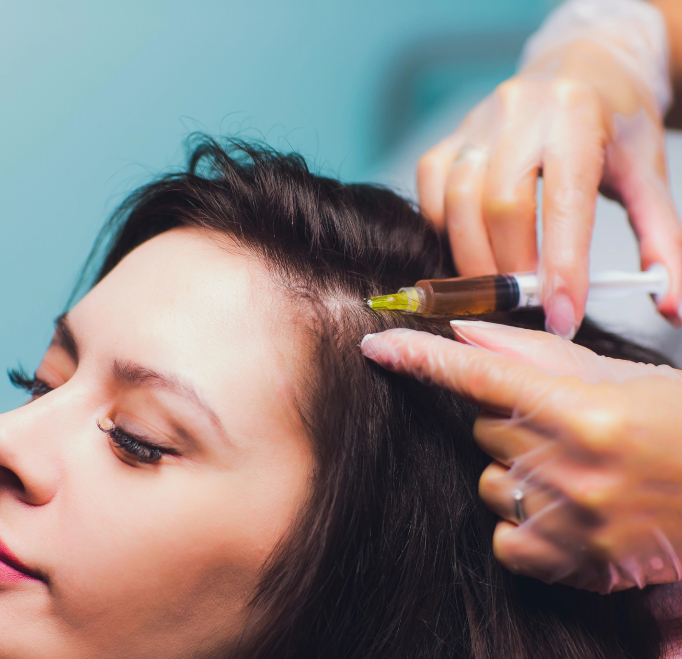
PRP is based on applying platelet-rich plasma obtained from the person’s own blood to the scalp.
The aim is to benefit from the tissue-repair-supporting properties of the growth factors contained in platelets.
In hair loss, PRP may be included in a treatment plan, especially for suitable patient groups, to help support the environment in which hair follicles are located and preserve hair quality.
However, PRP does not produce the same result in every type of hair loss. It should not be expected to create a new follicle in areas where the hair follicle has been completely lost.
What Is Magellan PRP?
The preparation systems used in PRP applications can affect the content and platelet concentration of the plasma obtained.
Magellan PRP is one of the systems that enables platelet-rich plasma from the person’s own blood to be prepared in a controlled manner.
The prepared PRP can be applied to selected areas of the scalp. The aim is to support biological processes around the hair follicles by making use of the growth factors in platelets.
The suitability of the procedure and the session plan are determined according to the person’s type of hair loss and clinical findings.
What Is Hair Mesotherapy?
In hair mesotherapy, substances that may contain vitamins, amino acids, minerals, and different active components are applied to the scalp using microinjections.
The content to be used is not standard. Different protocols can be created according to the needs of the person’s hair and scalp.
Mesotherapy may be considered particularly to support hair quality and complement the existing treatment plan.
However, if iron deficiency, thyroid disease, or a hormonal problem underlies the hair loss, mesotherapy alone does not remove the fundamental cause.
For this reason, supportive procedures should not replace treatment of the underlying cause.
What Is the Fotona Hair Restart Hair Laser?
Laser applications are among the energy-based methods used for hair loss.
Fotona Hair Restart is a protocol based on applying controlled laser energy to the scalp. The procedure aims to stimulate scalp tissue in a controlled way and support the microenvironment in which hair follicles are located.
The procedure is non-surgical and does not aim to create a noticeable wound on the skin surface.
The place of hair laser in treatment should be determined by assessing the type of shedding, the current thickness of the hair shafts, and the condition of the hair follicles.
While it may be considered alone for some people, it may be used together with PRP or medical treatments in some treatment plans.
What Is Tricopat?
Tricopat is one of the technologies that aims to support the hair and scalp microenvironment by combining different physical stimuli directed at the scalp.
The main aim of the procedure is to prepare the scalp for treatment, support application of selected active components, and help improve the environment in which hair follicles are located.
Tricopat should not be regarded as a solution on its own for every type of hair loss.
The stage at which it is used is determined according to the cause of the hair loss and the person’s current treatment programme.
Are Stem-Cell Applications Used for Hair Loss?
The term “stem cell” has been used frequently in hair-loss treatment in recent years. However, because different methods and biological materials may fall under this heading, it is necessary to state clearly which application is being discussed.
Some autologous cellular or tissue-derived applications aim for cellular components obtained from the person’s own tissue to support regenerative processes in the scalp.
Methods in this area continue to develop and should not be regarded as a standard application for every type of hair loss.
In particular, definitive statements such as “it creates new hair roots” or “it stops hair loss completely” are not scientifically correct.
The person’s suitability, the nature of the method to be used, and the available scientific evidence should all be considered together during dermatological assessment.
Which Is More Effective, PRP or Mesotherapy?
This is one of the most frequently asked questions in hair-loss treatment. However, directly comparing the two applications is not always appropriate.
PRP uses platelet-rich plasma obtained from the person’s own blood, whereas mesotherapy applies different active components to the scalp. Their mechanisms of action are therefore not the same.
PRP may be preferred for some people, while mesotherapy or other methods may be included in the treatment plan for others. When necessary, the methods may also be considered together.
The right question is not “Which is stronger?” but “Which is needed for this hair loss?”
Why Is a Combined Approach Important in Hair-Loss Treatment?
A single application may not always be sufficient for hair loss.
For example, in androgenetic hair loss, medical treatment planned by a dermatologist forms the main approach, while procedures such as PRP or laser may be considered as supportive measures.
In shedding related to iron deficiency, rather than only performing a procedure on the scalp, it is necessary to identify the cause of the deficiency and plan the required treatment.
For this reason, a combined approach to hair loss does not mean performing as many procedures as possible. It means addressing the different causes of shedding with the right methods.
How Many Sessions Are Hair Treatments Applied Over?
There is no standard number of sessions.
The session plan:
- the type of hair loss,
- the duration of the shedding,
- the thickness of the hair shafts,
- hair density,
- the method used,
- the person’s response to treatment.
may vary according to factors such as these.
The intervals for PRP, mesotherapy, hair laser, and device-assisted applications may each differ.
Dermatological reviews at regular intervals during treatment allow the response achieved to be assessed and the plan to be changed when necessary.
When Are Results of Hair Treatment Seen?
Because of the hair growth cycle, it is not possible to assess changes from hair treatments within a few days.
The biological response of the hair follicles and the growth of new hairs take time. Treatment results are therefore generally assessed over months.
Although a reduction in shedding may be noticed at the initial stage, assessing changes in the thickness and density of the hair shafts may take longer.
It should be remembered that results may vary from person to person.
Is It Necessary to Use Vitamins for Hair Loss?
Deficiencies in iron, vitamin D, B12, zinc, and certain nutritional factors may accompany hair loss.
However, this does not mean that everyone experiencing hair loss needs to use vitamin or mineral supplements.
Unnecessary or high-dose supplement use may not provide benefit and may also cause health problems in some cases.
For this reason, where a deficiency is suspected, it is a more appropriate approach to carry out the necessary laboratory assessments and plan supplementation according to the identified need.
When Should a Dermatology Specialist Be Consulted for Hair Loss?
Dermatological assessment should not be delayed if hair loss has persisted for a long time, if a marked reduction in hair density has begun, or if localised bare areas have developed on the scalp.
In particular:
- sudden onset of intense shedding,
- coin-shaped hair loss,
- redness or scaling on the scalp,
- noticeable recession of the hairline,
- accompanying loss of eyebrows or eyelashes,
- pain or burning on the scalp.
are findings for which the cause of the shedding should be investigated.
In some hair diseases, early diagnosis may be important for preserving existing hair follicles.
In hair-loss treatment, PRP, Magellan PRP, mesotherapy, Fotona Hair Restart, Tricopat, and applications aimed at cellular regeneration are options that work through different mechanisms. However, no method is a standard treatment on its own for every type of hair loss.
First, it should be determined whether the shedding is associated with androgenetic alopecia, telogen effluvium, nutritional deficiency, hormonal change, or another hair disease.
In an Istanbul dermatology specialist assessment, the aim is not simply to perform a procedure on the scalp, but to identify the cause of the shedding and create an individual treatment plan consisting of medical and supportive methods.
The most important step in hair treatment is the correct diagnosis before the procedure.
Frequently Asked Questions
Does PRP make hair grow?
PRP may be used to support the environment in which existing hair follicles are located and hair quality. It is not correct to expect it to create new follicles in place of hair follicles that have been completely lost.
Is PRP or hair mesotherapy better?
The contents and mechanisms of action of the two methods differ. The appropriate application is determined according to the cause of the hair loss and the person’s needs.
Can hair laser be used for hair loss?
Laser protocols such as Fotona Hair Restart may be included in the treatment plan for suitable people to support the scalp and the microenvironment in which hair follicles are located.
What is Tricopat hair treatment?
Tricopat is a device-based application that aims to support the scalp through different physical mechanisms. How it is used is determined according to the person’s type of hair loss.
Does stem-cell treatment produce new hair?
There are different applications marketed under the name “stem cell”, and it is not correct to promise a definite result that these methods create entirely new hair follicles. The scientific basis of the method to be used and the person’s suitability should also be assessed.
Can hair-loss treatment be started in autumn?
There is no need to wait for a particular season to begin hair-loss treatment. However, a necessary treatment plan may be made after assessing whether increased shedding at the end of summer is seasonal.